
Could We Have This Hyperrealistic 'Boyfriend on Demand' in Real Life?
VR · AI Companion · Dating Simulation · LLM

Subscribe and date up to 900 virtual boyfriends, plus a custom one built for you
Boyfriend on Demand is a 2026 Netflix K-drama that features a VR dating app with 900 virtual boyfriends to choose from, plus one slot to build your own from scratch.
As a product builder, I am amazed by how the writer thoughtfully productized the service.

This fictional dating simulation service has various aspects that are important for launching a product. The free trial ends right before a kiss. When you try to cancel, your virtual boyfriend tells you he’s afraid of losing you. There’s even a 10-scenario daily cap so you can’t binge through the whole catalog in a week. Whoever crafted this clearly made the service imaginable to have in real life.
Put on a headset and step into a complete dating scenario: Joseon-era royal, secret agent mid-mission, college campus slow burn. The plot unfolds around you, including physical touch, while your real body stays still.
900 characters in the catalog, each with distinct looks, personality, and a story arc built around them.
One slot is reserved for a character built entirely to your specifications of appearance and personality.
These boyfriends can text and call your real phone number. When you stop logging in, your boyfriend might even send a postcard to your house.
If you work in VR, AI companions, or consumer dating products, you’ll want to read the feasibility breakdown below and find inspirations for an actual product.
WHO COULD BENEFIT FROM IT
There’s the person who gets home after a 12-hour day and has nothing left for small talk, but still wants to feel like someone is glad they’re back. There’s the person who’s been burned enough times that the idea of putting themselves out there again feels exhausting, but who still misses what connection feels like. This could be a healing platform for them.
And there’s the person who’s just curious, who wants to try a different version of themselves in a relationship before committing to anything real. This could be an insightful simulation to prepare someone for a real relationship and understand their preferences, non-negotiables. Just like the protagonist in the series who later committed to a real life relationship.
REALITY CHECK AT A GLANCE
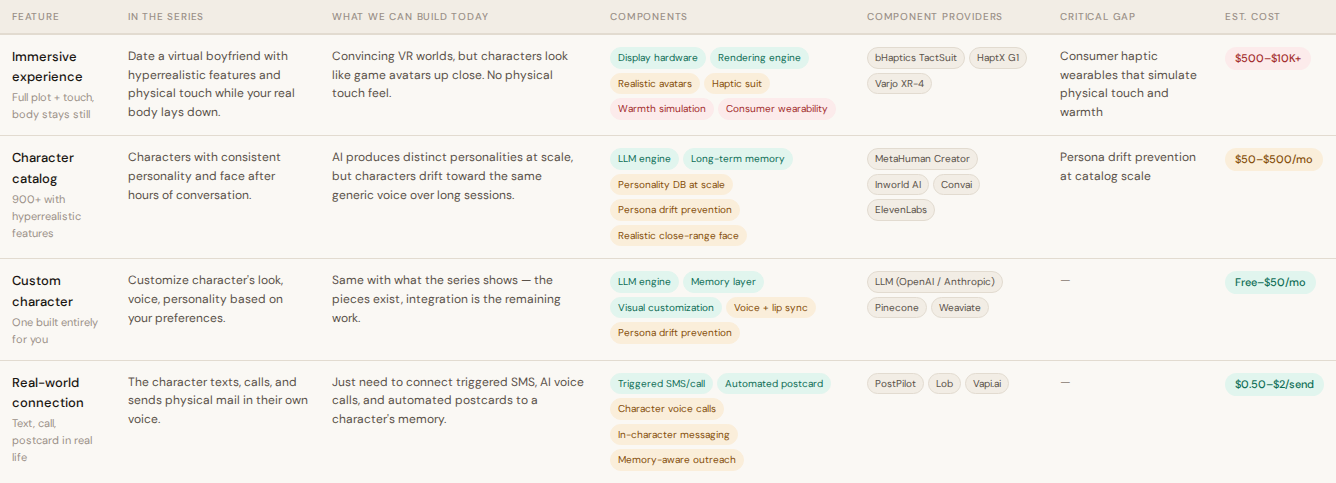
Here is where each feature stands today against what the show depicts.
FEATURE 1 OF 4
Experience the plot, including physical touch, without moving your real body

Keeping your real body still while the VR plot plays out sounds like a luxury, but it’s actually the only design that works at consumer scale. VR doesn’t require you to physically walk around. You can simulate movement by walking in place or using a controller, so being stationary isn’t a hard technical constraint. If the experience required dedicated floor space or specific room setup, you’ve just turned a consumer app into a venue. Stationary use means someone in a small apartment in New York can use this the same way as someone in a living room in Seoul. Current headsets like Meta Quest 3 can render convincing environments today: the Joseon palace, the college campus, the mid-flight spy thriller.
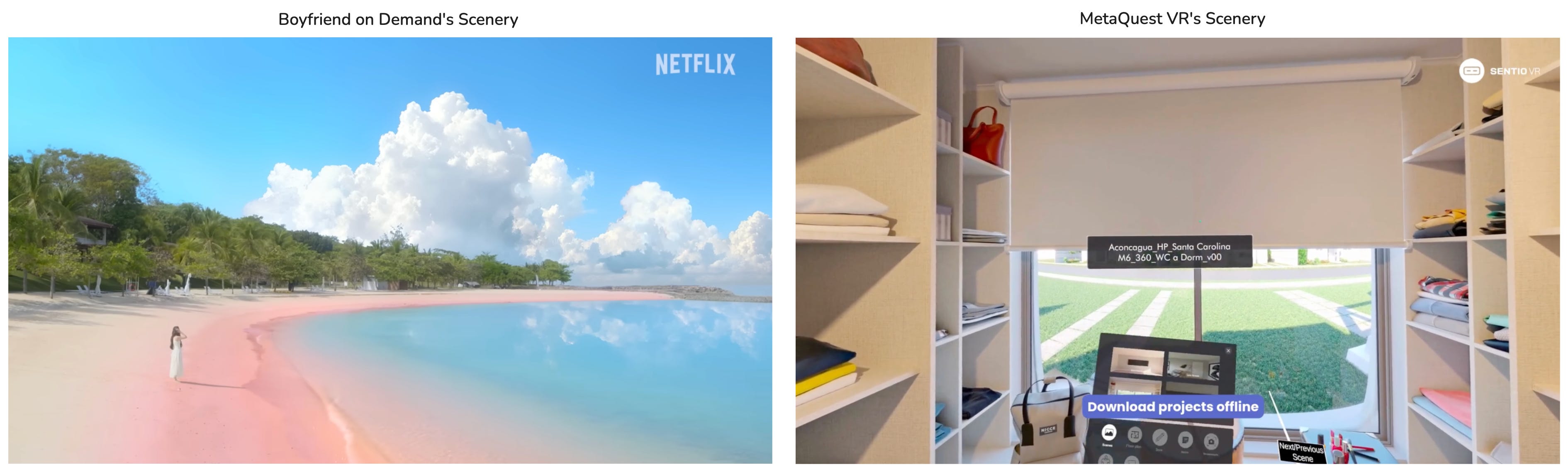
The part that isn't solved is the lying-down part. Headsets today are built for upright use: the weight distribution, strap design, and display orientation all assume you're sitting or standing. Someone lying on their couch the way protagonist does in the show would find the headset uncomfortable within minutes and the display fighting gravity. That's a form factor problem, not a software one, and no consumer headset has addressed it yet.
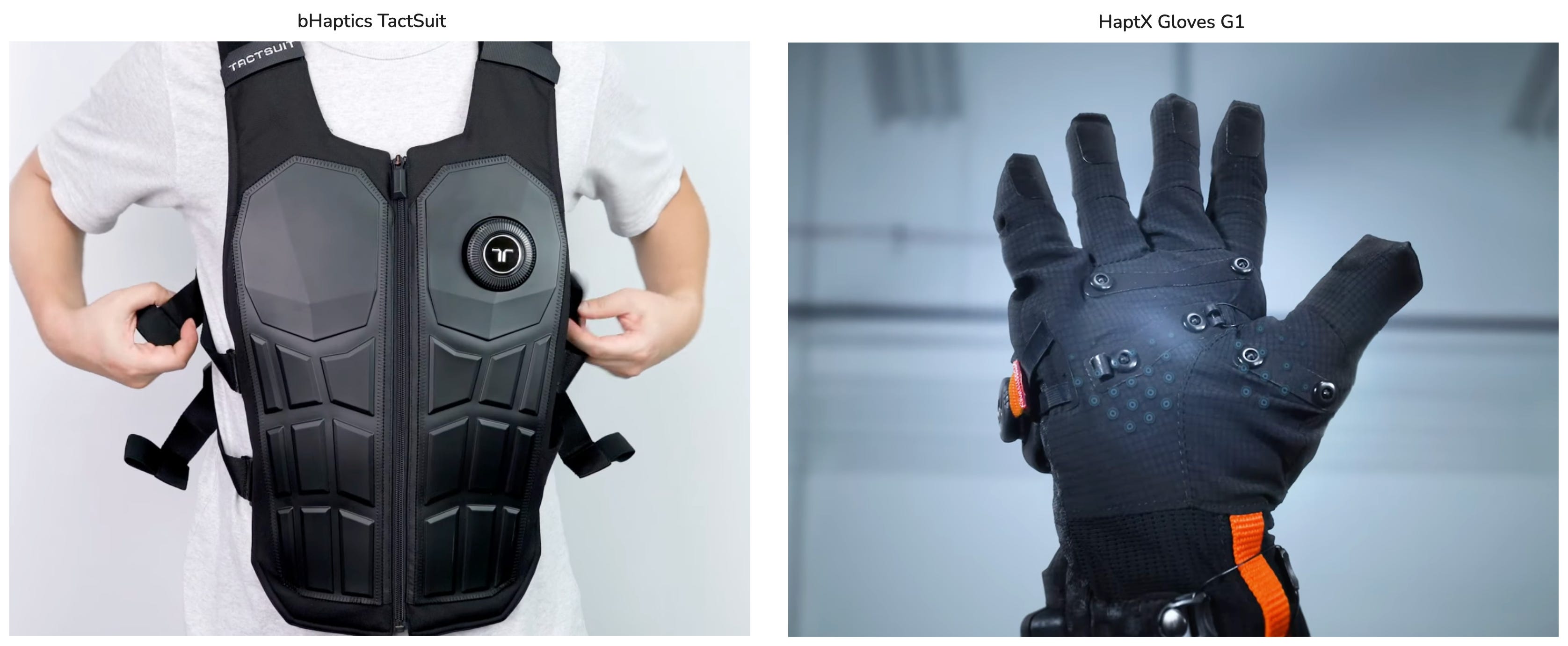
Physical touch is the hardest problem in this entire product. Consumer haptic vests like bHaptics TactSuit exist at under $500 and cover impact and vibration across the torso — but they cannot simulate the weight of a hand on your shoulder, warmth, or fabric texture. Those require actuator types that haven’t been miniaturized for wearables yet. The best force-feedback gloves available, HaptX G1, cost $5,500 a pair, require a tethered air compressor, and are sold only to enterprise customers. Besides, it looks impractical to carry around.
Another gap is the hyperrealistic rendering of characters. AI-generated characters look fine at a distance, but the face starts to break down when you get too close. The eyes don’t track naturally, micro-expressions are missing, hair still renders like geometry. Displays that correct depth perception at close range became commercially available in 2025 — Varjo XR-4 starts at around $3,990/year on subscription — but that's still enterprise pricing. Until they reach consumer pricing, any VR dating product will feel slightly uncanny the moment a character looks directly at you.
FEATURE 2 OF 4
900 virtual boyfriend characters with hyperrealistic physical features
Managing 901 characters means we need to store personality definitions, visual assets, and backstories of each.
The hard part is keeping every character sounding like themselves after 50 hours of conversation with a real user. LLMs today can hold deep contextual conversations, and long-term memory across sessions exists in every major AI platform. A character defined as guarded and hard to impress will later start softening in ways that feel inconsistent with who they’re supposed to be.
This problem is known as persona drift: the tendency for a model to gradually blur toward a generic, agreeable assistant voice the longer a conversation runs. An AI wrapper or system prompt layer can slow this down, but it doesn’t solve it entirely. Proper anti-drift architecture requires training-level solutions — though recent research from Anthropic suggests activation capping (constraining neural activity to prevent persona drift) could stabilize character consistency in long conversations without sacrificing model capability.
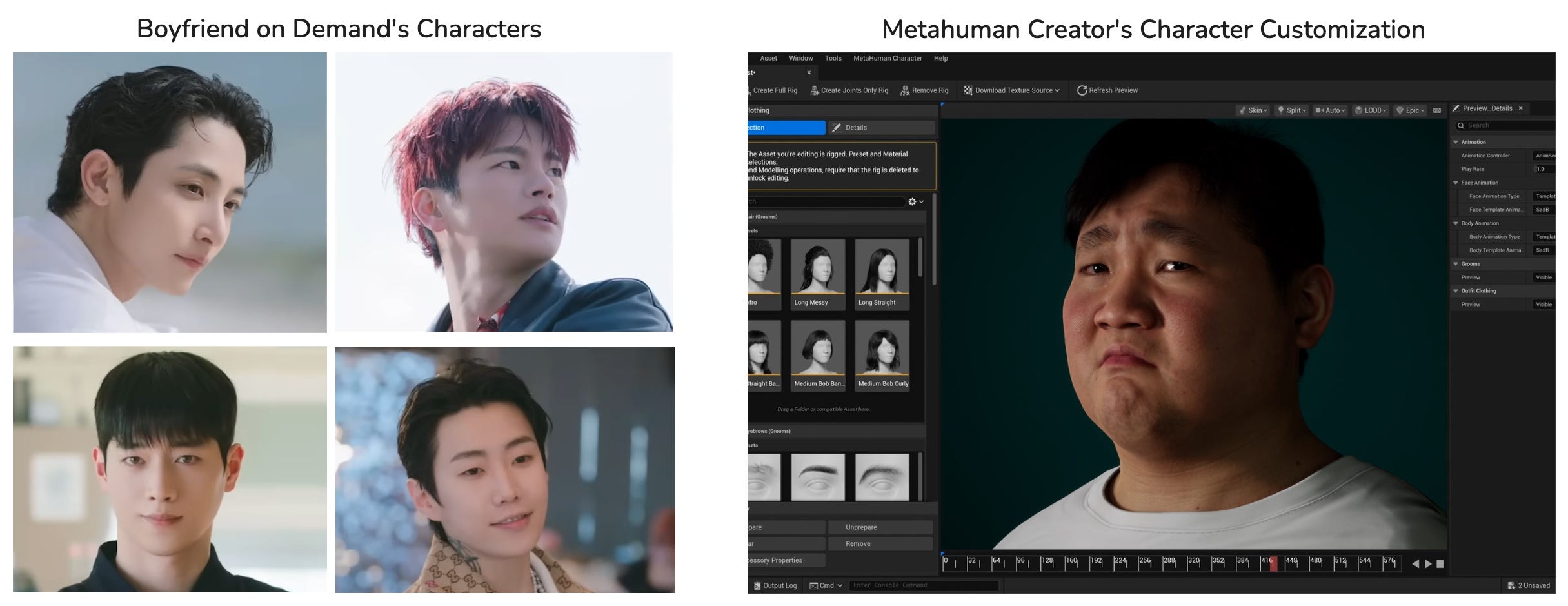
The visual consistency is another problem to solve. How do you store and reproduce a character’s exact facial geometry reliably across hundreds of sessions? The most likely path is procedural character generation, where AI generates and stores a consistent face model per character. Instead of drawing a face freehand every time, it stores a set of numerical values: the exact measurements, proportions, and attributes that define that character's face, and rebuilds from those same numbers every time. Think of it like a recipe versus a painting. A painting done twice by hand will never be exactly identical. A recipe with exact measurements produces the same dish every time.
MetaHuman Creator by Epic Games already does this for game studios — it's what powers character fidelity in titles like Senua's Saga: Hellblade II. Platforms like Inworld AI and Convai are built specifically to manage catalogs of distinct AI characters at scale, with memory and personality persistence built in.
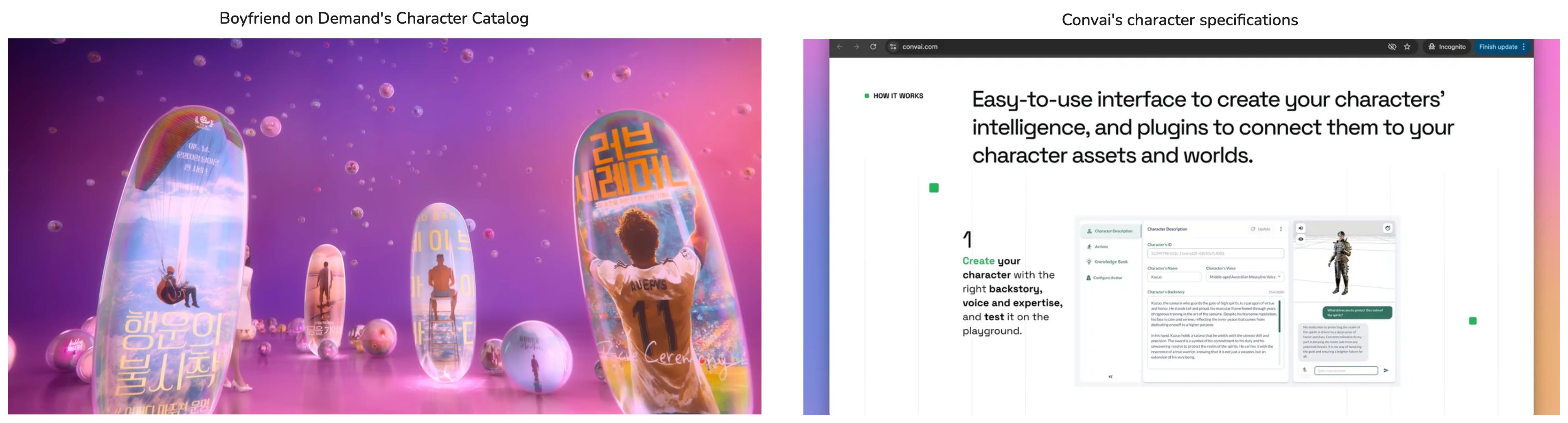
Custom voice per character is also worth addressing here. A catalog of characters each needing a distinct, consistent voice is a significant production challenge. ElevenLabs supports custom voice creation from a short audio sample, and their Flash v2.5 model achieves 75ms latency, which is fast enough for real-time conversation. The remaining gap is subtler: emotion is inferred from text cues rather than from the actual emotional arc of the conversation. A character can deliver the right words in the right tone, but if the conversation shifts emotionally, the voice won't pick up on it unless the text explicitly signals it. In practice, this is solvable at the dialogue generation layer as LLM tracks emotional state and writes responses that reflect it, then the voice model follows automatically.
FEATURE 3 OF 4
One custom character built entirely to your specifications

This is the most buildable feature in the product, and the one that sets Boyfriend on Demand apart from every other companion app that exists today. In the series, users have to answer 2,000 questions before the custom boyfriend is built. The form itself is trivial to build. A form builder like Typeform handles the 2,000-question intake.
The hard part is translating those 2,000 answers into a coherent character that a language model can inhabit consistently. This requires mapping user preferences into a persona specification — a set of parameters that defines not just facts about the character as part of procedural character generation. An LLM with a structured system prompt translates those answers into a persona specification. Vector databases like Pinecone or Weaviate store and retrieve long-term memory across sessions.
FEATURE 4 OF 4
The character reaches out in real life when you’ve been away
These boyfriends can text and call your real phone number. When you stop logging in, your boyfriend might even send a postcard to your house. That crossing from virtual into physical is what creates the emotional weight that keeps users from churning, and it also happens to be one of the most technically achievable features in this product.
Every component for this feature exists today, just not pointed at a companion app. PostPilot and Lob both offer behavior-triggered physical postcards sent automatically based on user inactivity. E-commerce companies use them to win back customers who haven’t purchased in 30, 60, or 90 days. AI-generated SMS and outbound AI voice calls both exist through platforms like Vapi.ai. The gap is integration and character fidelity: the message needs to sound like your specific boyfriend, referencing something real from your shared history, not a generic re-engagement nudge from a CRM. That requires piping the character’s memory layer and voice profile into the outreach system.
WHAT YOU COULD ACTUALLY SHIP TODAY
The physical touch layer is the only component that needs a hardware breakthrough that doesn’t exist yet. The rest of Boyfriend on Demand is buildable today. Unlike the series, this version lives on your phone and in your mailbox rather than inside a headset, but it would still be the first AI companion that reaches into your real life instead of staying trapped inside an app you open and close.
The fixed infrastructure to run an MVP such as memory layer, voice, catalog, and outreach pipeline costs around $320 a month regardless of how many users you have. At $30 a month per user, you break even on fixed costs at around 14 subscribers.
The harder number to pin down is variable cost. Every active user generates LLM token usage across up to 10 scenarios a day. Assuming each scenario runs 5,000–10,000 tokens (estimate for a meaningful conversation), LLM costs alone land at $4–15 per user per month at current API pricing. Add voice synthesis for every session and you’re looking at $8–20 per active user per month in variable costs.
At $30/month pricing that leaves $10–22 contribution margin per user. Workable, but tight enough that pricing closer to $40–50/month makes more sense at scale. At $50/month, you'd need around 100,000 subscribers to hit $5M monthly revenue.
For context, Nomi AI charges $25 a month and has been growing steadily since early 2026. The market isn't hypothetical. For $320 a month in fixed costs and a willingness to integrate, you could have a working version in front of real users before the next season drops.